

11 min read
AI Synthetic Performer Compliance 2026: What Sellers Must Know
Amazon, NY law, and EU AI Act now require synthetic-performer metadata on AI humans in product images. Learn what's required and how product-only imagery keeps you compliant.
Amazon, NY law, and EU AI Act now require synthetic-performer metadata on AI humans in product images. Learn what's required and how product-only imagery keeps you compliant.
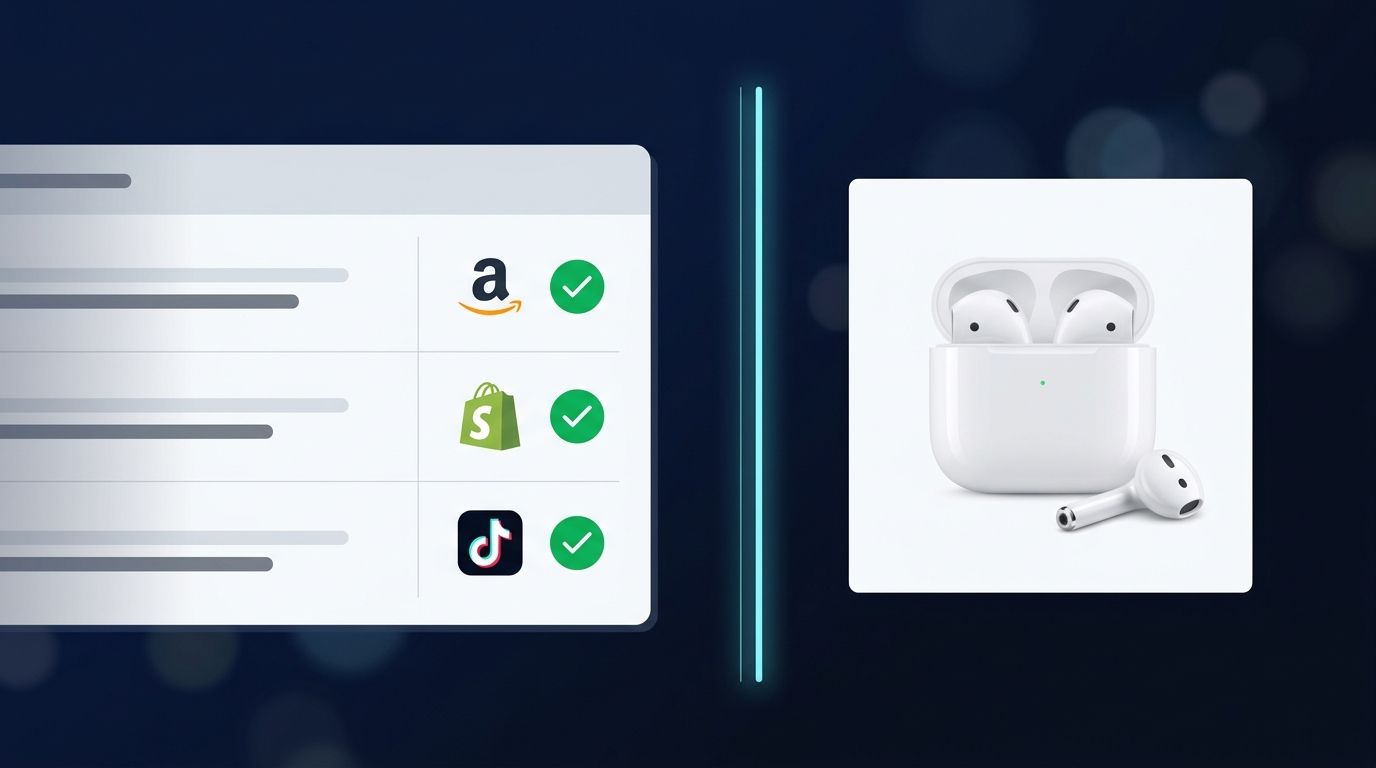
Amazon now requires metadata tags on AI-generated humans in product images (live July 23), New York's Synthetic Performer Law imposes $1K–$5K fines for undisclosed AI people in ads (effective June 9), and the EU AI Act mandates C2PA metadata plus visible labels (live August 2). Sellers must audit their catalogs to distinguish real models from fully synthetic humans, implement machine-readable metadata and platform-specific disclosures, and consider product-only imagery workflows to sidestep synthetic-performer rules entirely.
Three laws landed in your inbox this summer. You probably missed at least two of them.
By now, most e-commerce sellers know Amazon's July 23 announcement about synthetic-performer metadata tagging. Fewer realize the New York Synthetic Performer Law has been enforceable since June 9—and fewer still understand how the EU AI Act's Article 50 transparency requirements, now live as of August 2, will reshape your image supply chain across all platforms. These aren't three separate problems. They're one compliance puzzle with three different rule books, and the fines stack.
The good news: the rules are narrowly scoped. They target photorealistic AI-generated humans only. Product-only imagery—white backgrounds, flat-lay, close-ups, 360 spins, lifestyle backgrounds without people—is exempt across all three regimes. If you're already using AI tools to generate product shots without models, you're compliant by default. If you're using real models even with AI retouching, you're also fine. The problem is the middle ground: lifestyle imagery with AI-generated or heavily modified synthetic humans, which now requires metadata tags, platform disclosures, and careful documentation.
Let's break down what you actually need to do, platform by platform, and why product-only imagery is becoming the strategic compliance edge for sellers who move fast.

contains-synthetic-performer metadata requirement (July 23, 2026)Amazon's announcement is case-sensitive and technically specific: sellers must embed the exact keyword contains-synthetic-performer (lowercase, with hyphens, 28 characters) into the IPTC metadata (XMP dc:subject field) of any product image or A+ content containing photorealistic AI-generated humans before upload. This applies globally across all Amazon storefronts.
Here's the catch that trips up most sellers: retroactive tagging doesn't work. If you upload a file without the metadata, you cannot add it later. The listing goes live untagged. You must re-upload the corrected file. For sellers managing thousands of SKUs, this is a supply-chain problem, not just a compliance checkbox.
New York's law is already in effect. Any advertiser whose ads reach NY audiences must disclose use of photorealistic AI-generated humans in their ad creative—and the disclosure must be visible to consumers, not buried in footnotes. First violation: $1,000. Each subsequent violation: $5,000. Apply this to a brand running national ads across Meta, Google, and TikTok, and a single untagged campaign could cost tens of thousands before legal review catches it.
The law explicitly exempts real people (even if AI-edited), expressive works (films, games, TV), and product-only imagery. The operative word is photorealistic AI-generated humans. A cartoon character or a real model with standard color grading won't trigger it. But a fully synthetic face or body created by Midjourney, DALL-E, or Stable Diffusion will.
The EU approach is stricter and broader. Article 50 requires that any image or video substantially modified by AI—including AI-generated backgrounds, deepfake faces, or synthetic humans—must carry cryptographically signed C2PA (Content Provenance) metadata embedded in the file and a visible disclosure label (using free EU Commission icons) when shown to EU consumers. Penalties: up to €15 million or 3% of global annual turnover. There's no carve-out for small businesses or accidents.
Three rules, three different enforcement layers—but all three exempt product-only imagery. That's the compliance shortcut.
The metadata standard C2PA is emerging as the industry baseline. TikTok's auto-detection has already labeled 1.3 billion videos, making it hard to hide undisclosed AI content. Once embedded, C2PA metadata persists through format conversions and compression, creating a permanent compliance record.
Upload one image and get studio-quality product photos, on-model shots, and ad creatives — no camera, no studio, no wait.
Try Seenable AI freeNo credit card required · 130 free credits included
 Before
 After
After
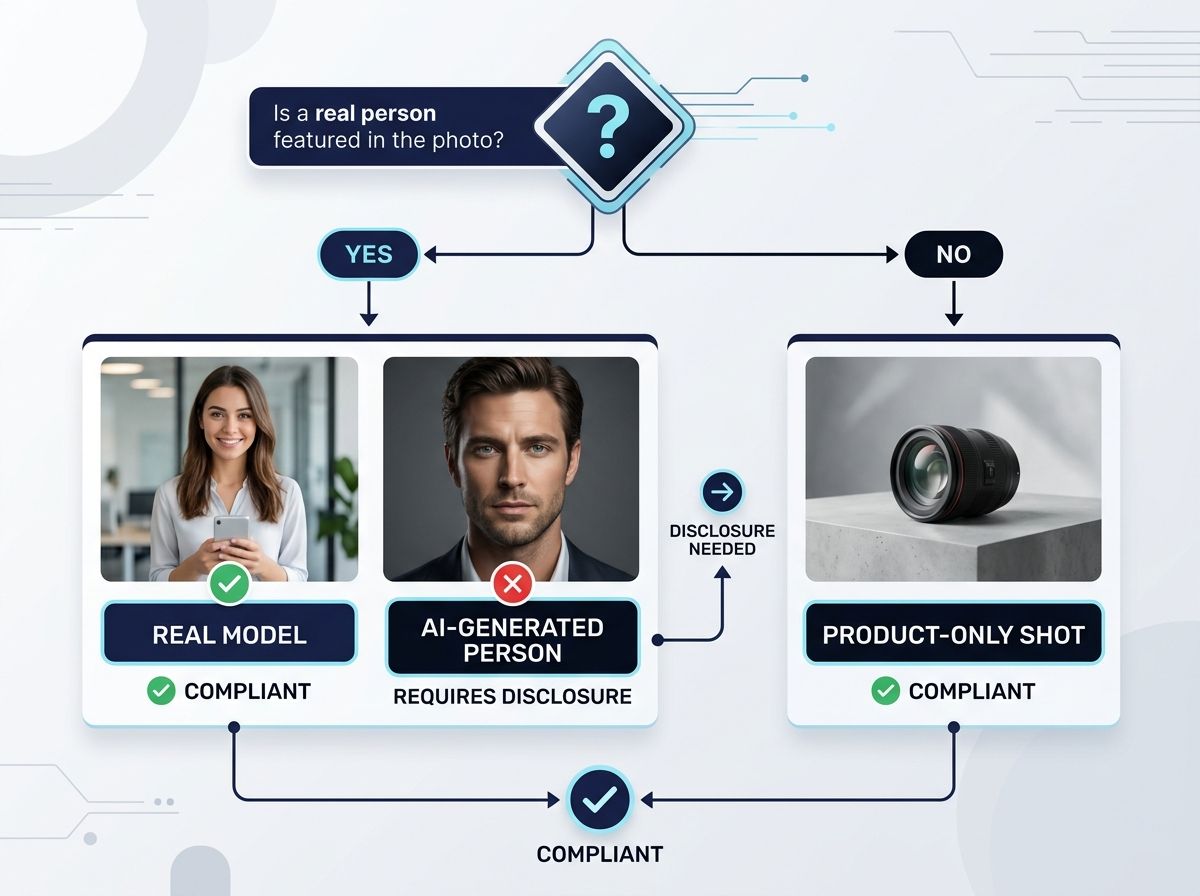
The critical distinction is simple in principle, messy in practice: if a real person sat in front of a camera or was captured in a photograph—even with AI enhancement afterward—no disclosure is required. If the entire human likeness was created by an AI tool from a text prompt with no real person present, tagging and disclosure are mandatory.
Most sellers don't know which side of that line their catalog falls on.
A practical 30-day audit workflow should document each image's origin (real photoshoot, AI-generated from scratch, stock photo + AI editing, etc.), the degree of AI modification (standard color grading vs. synthetic face generation), and the intended platforms. Then classify each as compliant or requiring disclosure.
Start by inventorying. How many product images do you upload monthly? Most sellers ship 50–500 monthly. How many contain people? Of those, which were photographed with real models, and which were generated entirely by AI? Build a decision tree: Did a real person sit for this photo? If yes—even if AI tools retouched it later—no disclosure needed. If no, does it contain a photorealistic human? If yes, it requires tagging and disclosure.
Documentation is your defense. Create a compliance scorecard for each image: source, classification, platforms used, disclosure status, approval sign-off, date. This protects you against regulator inquiries and supports platform appeals if a listing is incorrectly flagged or removed. When (not if) someone asks, "Did you know this image was synthetic?" you have evidence of due diligence.
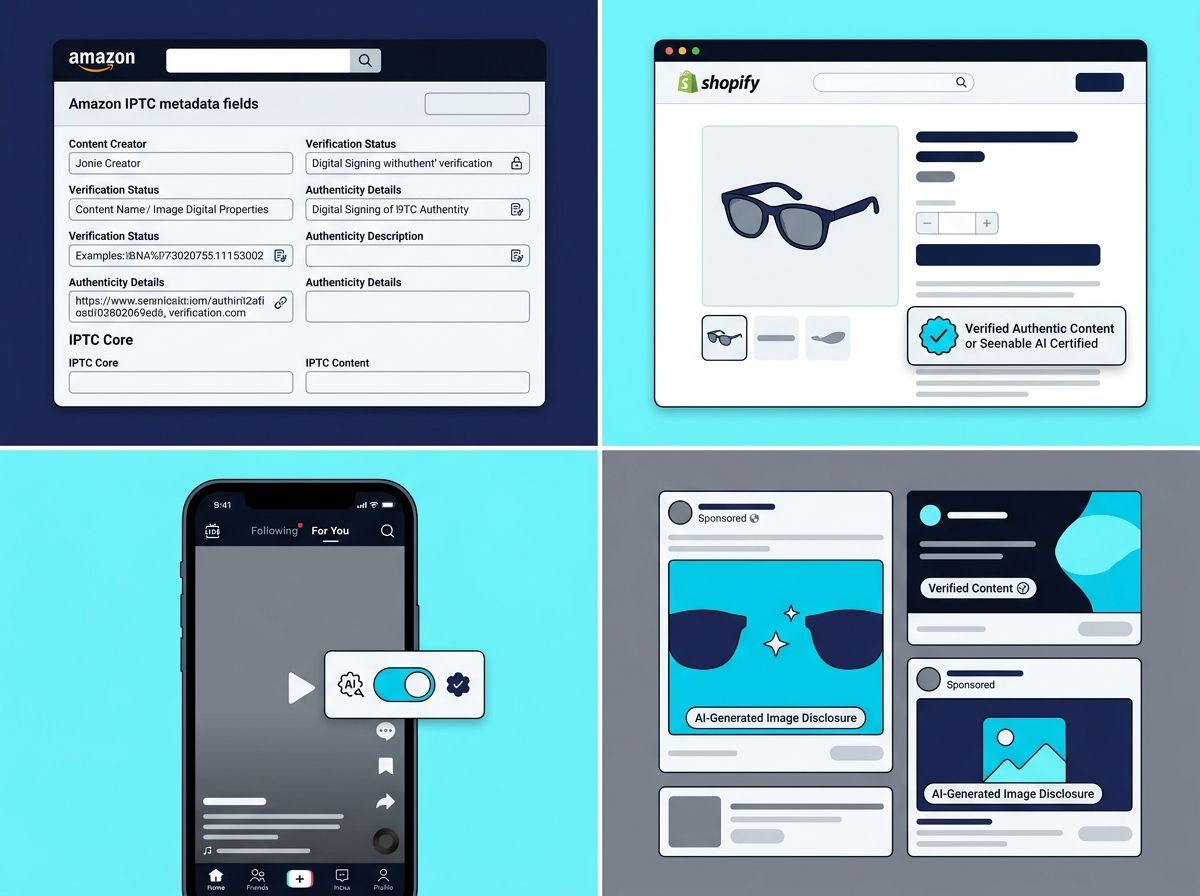
Amazon requires the exact keyword contains-synthetic-performer added to the IPTC Keywords field before upload. Use tools like ExifTool (command-line), Preview (macOS), or File Explorer (Windows) to embed the tag. Verify the metadata is present before uploading. If you miss it, re-upload the corrected file.
Shopify doesn't currently require backend metadata like Amazon does, but best practice is to add C2PA metadata at the file level (using tools like Kontainer or Adobe) and display a visible disclosure badge near product images. This satisfies EU AI Act transparency requirements and builds consumer trust. A simple label like "AI-generated content" near the product image during checkout is sufficient.
TikTok Shop requires activation of the "AI-generated content" toggle in the content management interface. TikTok's system auto-detects C2PA metadata and may algorithmically suppress unlabeled AI content, feeding into Account Health Ratings and affecting organic reach. Sellers who ignore this face reduced visibility and potential account warnings.
Meta, Google, and TikTok Ads all require a visible disclosure when synthetic humans appear in ads. The disclosure must be legible and persistent during the full duration of any AI-persona product claim. Format is unspecified, but it must be prominent—not in footer text, not in a disclaimer fold. Think: "Created with AI" overlaid on the image or prominently displayed in ad copy.
Upload one image and get studio-quality product photos, on-model shots, and ad creatives — no camera, no studio, no wait.
Try Seenable AI freeNo credit card required · 130 free credits included
 Before
 After
After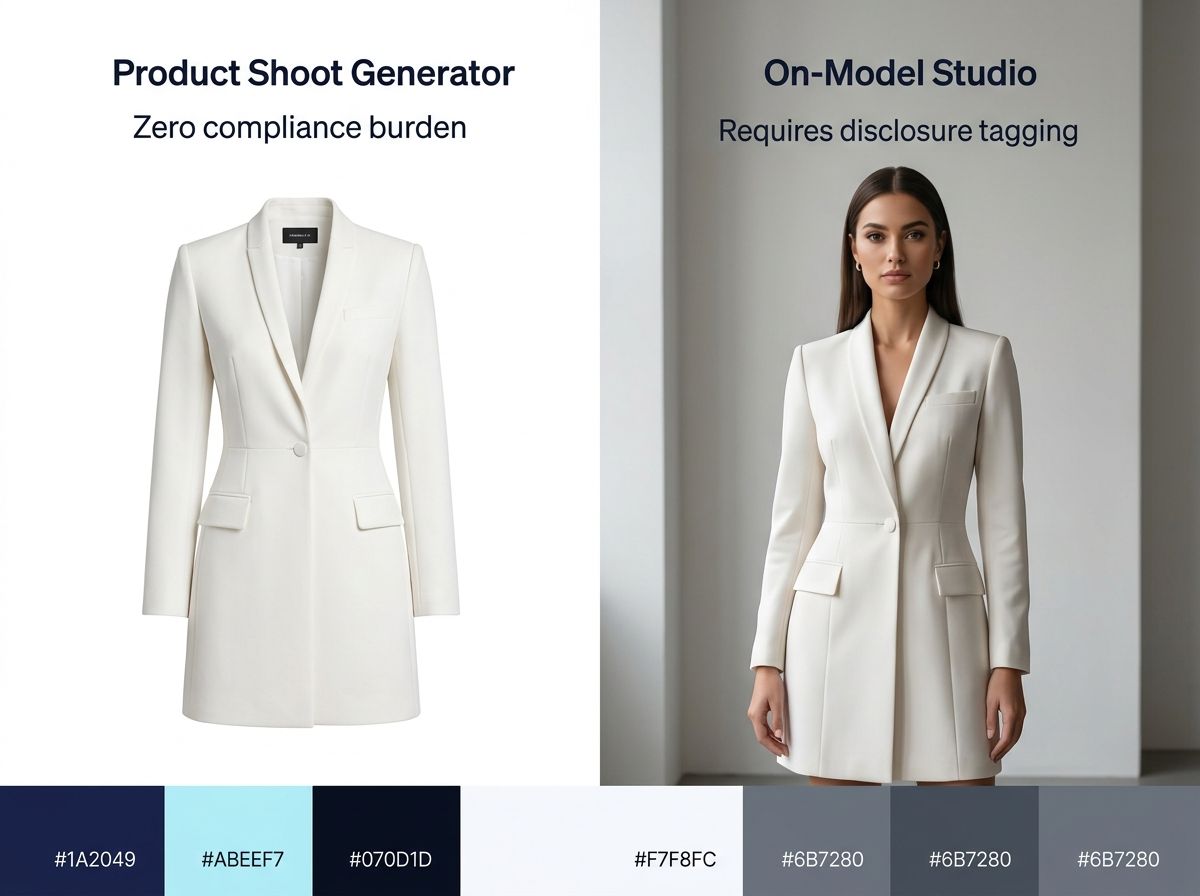
Here's the strategic insight: Amazon, NY law, and EU AI Act all explicitly exempt product-only imagery from synthetic-performer rules. White backgrounds, flat-lay, close-ups, technical shots, 360-degree spins—any content without photorealistic humans, real or synthetic—has zero compliance burden.
Seenable's product-only image tools (Product Shoot Generator, Background Remover, White Background, Catalog Set) generate human-free output that is natively compliant and requires zero metadata tagging. These tools are the compliance-preferred path for sellers wanting to avoid disclosure complexity. Generate studio-quality product shots in seconds, export them immediately, and ship them with zero regulatory risk.
On-Model Studio is different. This tool generates photorealistic AI-modeled apparel and product shots with human figures. Those images require the same contains-synthetic-performer tagging and consumer-facing disclosures as any third-party AI-generated imagery. If you use On-Model, treat its output as synthetic and apply the full compliance workflow.
Free-tier Seenable outputs include watermarked previews for evaluation. Paid tiers include full commercial usage rights, batch export with IPTC metadata support, and platform-specific exports (Amazon, Shopify, TikTok) with compliance flags built in. All outputs include machine-readable C2PA metadata to support multi-platform disclosure.
Relying on metadata alone doesn't satisfy regulatory requirements. Sellers must layer three components:
For sellers managing catalogs of 100+ images, automation is essential. Batch metadata embedding using tools like ExifTool or Seenable's batch export feature prevents manual errors and creates audit trails. Workflow: classify images → embed C2PA → export to platform-specific formats → add platform-specific disclosure → log and archive.
Procurement teams rating third-party AI tools should assess whether they emit C2PA metadata by default, preserve IPTC fields during processing, support batch workflows, and publish compliance documentation. Tools that strip or obfuscate metadata create downstream friction.
Upload one image and get studio-quality product photos, on-model shots, and ad creatives — no camera, no studio, no wait.
Try Seenable AI freeNo credit card required · 130 free credits included
 Before
 After
AfterSeenable's free trial requires no credit card and includes access to Product Shoot Generator, Background Remover, White Background, and Catalog Set—all human-free tools exempt from synthetic-performer rules. Generate sample product images, export them with embedded C2PA metadata, and test platform uploads to understand how compliance works across your channels.
Free and paid users can export images with platform-specific configurations: Amazon exports include IPTC contains-synthetic-performer metadata pre-embedded; Shopify exports include C2PA provenance data; TikTok exports flag AI-generated status in accompanying JSON.
Seenable's in-app compliance checklist walks new users through a 10-step audit: inventory catalog by platform, classify each image, generate sample product shots, compare quality and compliance overhead, test multi-platform export workflows, review metadata embedding, upload test images to each platform, verify platform compliance warnings or approval, document findings, and plan rollout.
Start free, export immediately to understand platform-specific compliance workflows, then upgrade to paid tiers (Standard: $99/month; Pro: $299/month; Enterprise: custom) to unlock unlimited credits, batch workflows, and priority compliance support.
No. Amazon's rule explicitly exempts real people, even if AI tools were used to edit or enhance their images. The disclosure requirement applies only to photorealistic humans who were entirely generated by an AI tool with no real person present.
Amazon requires the exact keyword contains-synthetic-performer (lowercase, with hyphens) embedded in the IPTC Keywords field before upload. If the metadata is missing or incorrect when you upload, it cannot be retroactively added to a live listing—you must re-upload the corrected file.
Only photorealistic AI-generated humans trigger disclosure requirements. AI-generated backgrounds, product renders without people, and props are exempt from Amazon's rule and New York's law. Product-only imagery has zero compliance burden.
Yes, partially. Amazon uses IPTC metadata tagging (backend, machine-readable). New York law requires conspicuous consumer-facing disclosure. TikTok requires the "AI-generated content" toggle and may auto-label via C2PA. EU AI Act requires visible labels plus C2PA metadata. Best practice: embed C2PA metadata once at the file level, add visible disclosure badges on each platform's interface, and document the workflow.
Amazon may remove the listing or suspend your account. Under New York's law, advertisers face $1,000 for first violation and $5,000 for each subsequent violation if ads reach NY audiences. EU penalties can reach €15 million or 3% of global annual turnover. TikTok and Meta can suppress content or remove accounts.
Yes. Seenable's product-only tools (Product Shoot Generator, Background Remover, White Background, Catalog Set) generate human-free output that bypasses synthetic-performer rules entirely. Free-tier outputs include watermarked previews; paid tiers include full commercial rights and batch metadata export with platform-specific compliance flags.
Three compliance regimes. One solution framework. Product-only imagery sidesteps the entire synthetic-performer disclosure burden, and tools that embed C2PA metadata by default make multi-platform compliance repeatable instead of manual.
Start your free trial—no credit card required—and test compliant product imagery workflows with hands-on platform export guides. Audit your catalog, generate sample product shots, export to your channels, and see how fast compliance can actually be.
Start your free trial—no credit card required—and test compliant product imagery workflows with hands-on platform export guides.
Try Seenable AI free After
After
 After
After
 After
After